Prop Firms Without Consistency Rule: The $2,300 Lesson
That was the day I stopped trading accounts with consistency rules on funded accounts. Not during evaluation—I get why firms need some protection during the trial phase. But once you're funded and proving yourself week after week? Consistency rules are just a way to cap your upside while the firm keeps the downside protection.
Skip the Explanation?
If you just want to know which prop firms have no consistency rule on funded accounts, Lucid Flex is the one I use. After evaluation, there's zero consistency requirement.
Check Out Lucid Flex →Use code vedic for 40% off
What Exactly Is a Consistency Rule?
A consistency rule limits how much of your total profit can come from your best trading day. It's expressed as a percentage.
The formula: (Largest Single Day Profit / Total Account Profit) × 100 = Consistency Percentage
Example: You make $5,000 total profit. Your best day was $2,000. That's 40% consistency ($2,000 / $5,000 = 40%).
Common Consistency Rules by Firm:
| Prop Firm | Evaluation Consistency | Funded Consistency |
|---|---|---|
| Apex Trader Funding | 30% | 30% (YES) |
| Tradeify | 30-40% (varies by plan) | 30-40% (YES) |
| TopStep | None | 30% (YES) |
| Lucid Flex | 50% (with cushion) | NONE |
Why Firms Use Consistency Rules
I'm not going to pretend consistency rules exist just to screw traders over. Firms have legitimate reasons:
- Protection against gamblers: Someone who makes $10k on one YOLO trade and loses $500 every other day isn't a sustainable trader
- Risk management: Extreme wins often come from extreme risk, which firms want to avoid
- Identifying skill vs. luck: Consistent profits across multiple days suggest a repeatable edge
All of this makes sense during evaluation. You're trying to prove you can trade. The firm needs to filter out people who got lucky once.
The Problem: Consistency Rules on Funded Accounts
Here's where it gets ridiculous. Once you're funded, you've already proven yourself. You passed the evaluation. You're making the firm money. Yet many firms keep the consistency rule in place.
This creates perverse incentives:
- Month-to-date profit: $2,000
- Best day so far: $800 (40% of total)
- New opportunity: Clear 1:5 setup for potential $3,000 win
- The math: If I take full profit, my best day becomes $3,800 on $5,000 total = 76% consistency = BREACH
- My choice: Take $700 max to stay under 30%, or risk losing the entire account
I'm not overleveraging. I'm not gambling. I'm taking a textbook setup with proper risk management. But the consistency rule forces me to either:
- Leave $2,300 on the table
- Trade poorly on purpose for the rest of the month to "dilute" my best day
- Risk breaching and losing everything
That's not risk management. That's the firm capping your upside while they keep 100% protection on the downside.
What I Do Now: No Consistency on Funded Accounts
After that $2,300 lesson with Apex, I moved everything to Lucid Flex. Here's why:
Lucid Flex Consistency Structure
During Evaluation: 50% consistency rule with a built-in cushion. This is reasonable—they need to see you can trade consistently to pass the challenge.
On Funded Accounts: NO CONSISTENCY RULE. Zero. None. If you have a monster day, you keep 90% of those profits.
This means when NQ moves 800 points in an hour, I can take the full $3,000. When a perfect setup appears, I don't have to do mental gymnastics about percentages. I just trade.
Proof: My Biggest Day on Lucid Flex
February 6, 2026. Same day as the Apex disaster. But on my Lucid Flex accounts, I could take the full move.
Single day profit across 5 funded accounts:
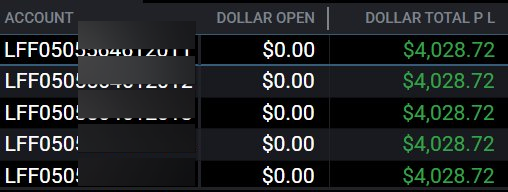
$4,028.72 on one day. With 2 mini lots. Copy-traded across 5 LucidFlex funded accounts (LFF505...).
No consistency breach. No penalty. Just 90/10 profit split like it should be.
If I was still on Apex with their 30% rule? I would have had to close at $1,208 total across all accounts to avoid breaching. That's $2,820 left on the table.
Understanding Lucid Flex's Evaluation Consistency
Even though Lucid Flex has no consistency rule on funded accounts, they do have a 50% rule during evaluation. But it's designed to be passable, not punitive.
The 50% Rule with Cushion
During the Lucid Flex challenge, your largest single-day profit can't exceed 50% of your total profit. But there's a built-in cushion that makes this forgiving.
Example (50k account):
- Profit target: $3,000
- 50% consistency threshold: $1,500
- Cushion amount: $1,560
This means you can pass in just 2 days if needed. Day 1: Make $1,500. Day 2: Make $1,500. You hit $3,000 total with 50% consistency exactly.
The cushion exists because the actual percentage is calculated on your real profit, not a fixed dollar amount. As long as you're not making 80% of your profit on one day, you'll pass.
More importantly: once you're funded, this goes away entirely. That's the key difference.
Comparison: Firms With and Without Funded Consistency
| Feature | Apex (With 30% Rule) | Lucid Flex (No Rule) |
|---|---|---|
| Evaluation Consistency | 30% | 50% (with cushion) |
| Funded Consistency | 30% (enforced) | None |
| Big Win Days | Capped or penalized | Keep full profit (90%) |
| Trade Management | Must calculate percentages | Just trade your edge |
| Monthly Profit Potential | Limited by best day | Unlimited |
When Consistency Rules Actually Make Sense
I want to be fair here: consistency rules aren't always bad. Here's when they're appropriate:
- During evaluation: Firms need to filter out lucky gamblers from skilled traders
- For extremely aggressive rules (like 80%+): If someone makes 80% of their profit on one day, that's worth investigating
- As a secondary metric, not a hard rule: Some firms review high-consistency days but don't auto-breach you
But on funded accounts where you've already proven yourself? Where the firm is making money from your trading? A hard consistency rule is just profit-capping.
Why I Switched to Lucid Flex
After losing $2,300 to Apex's consistency rule, I had a choice: keep fighting arbitrary limits, or find a firm that lets me trade properly.
I moved to Lucid Flex for three reasons:
1. No Consistency Rule on Funded Accounts
Once I'm funded, I can take every good setup without calculating percentages. My biggest day was $4,028 across 5 accounts. No penalty.
2. Reasonable Evaluation Consistency (50% with Cushion)
The 50% rule during challenges is fair. It proves I can trade consistently without being impossible to pass. And the cushion means I'm not walking on eggshells.
3. End-of-Day Drawdown (Not Intraday)
Combined with no consistency on funded accounts, this means I can actually trade momentum and volatility without artificial limits. If NQ moves 800 points, I can take the full move.
I've withdrawn over $40,000 from Lucid Flex accounts. That includes multiple $3,000+ days that would have breached me on Apex. The difference isn't my trading—it's the rules.
The Bottom Line
Consistency rules during evaluation: Reasonable. Firms need to see you can trade consistently before giving you capital.
Consistency rules on funded accounts: Profit-capping. You've already proven yourself. The firm is making money from your trades. Limiting your upside at this point only benefits them.
If you're serious about prop trading, use a firm that removes consistency rules once you're funded. Don't leave $2,300 on the table because of an arbitrary percentage.
🎁 Free Prop Firm Playbook
Get my complete guide to choosing and passing prop firm challenges. Includes the exact checklist I use to evaluate firms.
Download Free Playbook →Trade Without Consistency Limits
I use Lucid Flex for all my funded trading. 50% consistency during evaluation (with cushion), then ZERO consistency once funded. Take every good setup without artificial caps.
Start Your Lucid Flex Challenge →Use code vedic for 40% off
Want to see all the rules first? Check the complete Lucid Flex rulebook